Shooter Day 1
Shooter: Day 1
Chapter One
WEEK ONE · DAY ONE · CHAPTER ONE Thursday, October 1, 2026 · 3:30 AM · Marana, Arizona REMAINING: 168:00:00
The alarm went off at 3:30 AM, cutting through the silence of the Marana house like a blunt instrument.
Shooter swung his heavy frame out of bed, his lower back offering its customary, grinding objection before his feet even hit the floorboards. Fifty-one years old this coming Monday, October fifth. That made today Thursday, October first, another nine-hour grind standing between him and a weekend he couldn't afford to enjoy anyway.
Because it was the Thursday before an off Friday, the defense plant down on Old Nogales Highway was under casual dress rules. No collared overshirt required. He pulled on jeans and reached into the closet for one of his graphic tees, the black one his sister Tonya had gotten him with a single word printed dead center in white letters: Nope. Then he stepped into his worn slip-on Skechers. Never boots, ever. He'd spent too much of his adult life on his feet to subject them to stiff leather when comfortable foam did the job better.
His mother back in King, North Carolina, was the only person alive who still called him David, and only on Sunday afternoons when she checked in. To everyone else across southern Arizona he was strictly Shooter. Trevor, his brother-in-law from the first marriage, who rented the downstairs room, called him Shooter. George called him Shooter. Darren, his senior systems administrator peer down in Building 480 at Raytheon, called him Shooter. Even Krista, when she wasn't filing frantic motions through third-party family attorneys or screaming "hence why" at him, called him Shooter. To sixteen-year-old Nik and nineteen-year-old Liz, he was simply Dad. To his adopted nephew Juan, affectionately known as Shooter's Mountain, a six-foot-six, five-hundred-pound giant from Wellton who had claimed Shooter as his uncle just as Shooter had claimed him right back, he was Uncle Dave.
The name hadn't come from military service, and it damn sure hadn't come from hunting. As a two-time felon from ancient legal friction decades back, firearms were off the table by statute anyway. Besides, Shooter had always viewed a gun the same way he viewed a framing hammer, a miter saw, or an optical network transceiver: an inert tool. Useful if you had the discipline to handle it, neutral on the bench, and disastrous in an amateur's hands.
No, the name had come straight from the green felt.
Shooter was a craps player. Not an occasional tourist tossing five bucks in the field with a watered-down draft beer, but a student of the tub. Dice was a game of pure, unfiltered consequence, played everywhere from back-alley sidewalks to million-dollar pits ringed with armed security. It could hand a working man a down payment on a house in forty-five minutes, or strip him of his pride, his truck keys, and his dignity before the cocktail waitress could bring his lukewarm ginger ale.
He wasn't a degenerate about it. The rent was paid, the cabinets were full, and the utilities were current before a single chip crossed the rail. But when he had the time and the scratch, his church pew was stick-left-one. Being right-handed, it gave him the sightline down the wood, the leverage over the tub, and the clean, rhythmic wrist snap he wanted. He loved setting the red cubes in the 3V, locking his wrist, and running the numbers until the boxman looked like he needed an oxygen tank.
He loved the noise, the superstition, the clatter of clay against the rail and the sharp clack of two red cubes off the pyramid rubber on the back wall. He loved the guys who refused to touch the dice with their left hands, the old-timers who stacked chips by color in descending pyramids, and the paranoia that gripped an entire table the second somebody dared to say the word seven out loud.
He even loved the dreaded Point-Seven-Out. A PSO is a gut punch every time: the come-out roll, the point is established, you take your odds, and bam, the very next toss comes up big red and sweeps the felt clean before you finish arranging your chips. But that looming heartbreak is what gives the table its soul. Four in a row is a slaughterhouse. Still, if the guy holding the dice spent three full minutes setting the pips, blowing on his knuckles, and performing a five-step ceremonial shuffle just to fling a seven-out on the very next throw, well, as far as Shooter was concerned, the bastard kind of had it coming.
He padded downstairs past the living room rug and the sectional. Trevor's door was shut and the room behind it was dark. Bacon, Nik's AKC-registered German Shepherd, lifted his broad black-and-tan head, gave a single low snort of recognition, and let his chin drop back across his paws.
Shooter checked his pockets by muscle memory. Into the front left went his slim, matte-black Ridge knockoff with his debit card and driver's license. Around his neck hung his Raytheon facility pass on its REMOVE BEFORE FLIGHT lanyard. His key ring clipped to his belt loop, clinking against the denim.
He locked the front door and stepped into the garage at 3:55 AM.
The 2019 Ram Rebel sat nose-out toward the street. Shooter never backed down a driveway, ever. He always backed in when he came home so that at four in the morning, with his cognitive processors running on low voltage, he could drop the transmission into drive and pull straight forward with zero blind spots.
He climbed up into the driver's seat and pressed the start button. The 3.6-liter Pentastar V6 purred to life. Out over the front bumper, the passenger-side projector threw a clean wedge of white light across the driveway. The driver-side assembly stayed pitch-black. The internal ballast had fried two weeks back, and at four hundred dollars for an OEM replacement, the repair had been bumped down the ledger behind household overhead, groceries, and attorney retainers. One eye open, one eye blind, grinding forward anyway.
He took the Rebel down Thornydale to the Circle K on Tangerine and shut off the engine.
The air at five past four was cool and black, with no moon left in it and the first gray still two hours away. Shooter stepped down out of the cab and started toward the glass doors.
"Hey, boss."
He stopped dead on the concrete apron, his guard snapping up.
A man stood just outside the shadow of the canopy, leaning against the pale yellow stucco wall. He looked worn around the edges, not dirty exactly, but weathered by the kind of mileage that doesn't wash off. Faded denim jacket, cracked leather belt, hands shoved deep in his pockets. His eyes were the strangest part: open, steady, and empty, like the windows of a house nobody had lived in for a long time.
"Will you buy this coin from me for ten dollars?" the man asked. His voice was gravelly, quiet, and carried no tremble.
Shooter's first instinct was to say get lost. He had one rule he never broke: he did not hand out cash to people with their hands out. He was a conservative who believed in personal accountability and fixing your own problems. If he had to work for his money, so should everybody else, and a man who could stand on a corner with a sign could walk into a Goodwill and ask about job skills. Handouts bred complacency, and he didn't work fifty hours a week behind security wire to subsidize bad decisions.
"I don't give away cash," Shooter said flatly, in a low Carolina rumble.
"I didn't ask for a handout," the man replied evenly. "I asked if you'd buy a coin. Ten bucks."
Shooter narrowed his eyes. No twitching, no shifty eyes hunting for an angle. Just a quiet, dead-serious transaction.
"Can I see it?"
The stranger slowly drew his right hand from his jacket pocket. He didn't toss it, and he didn't reach out to hand it over. He flattened his palm, fingers stiff and level at chest height, and let the metal rest open under the canopy lights.
Shooter leaned in.
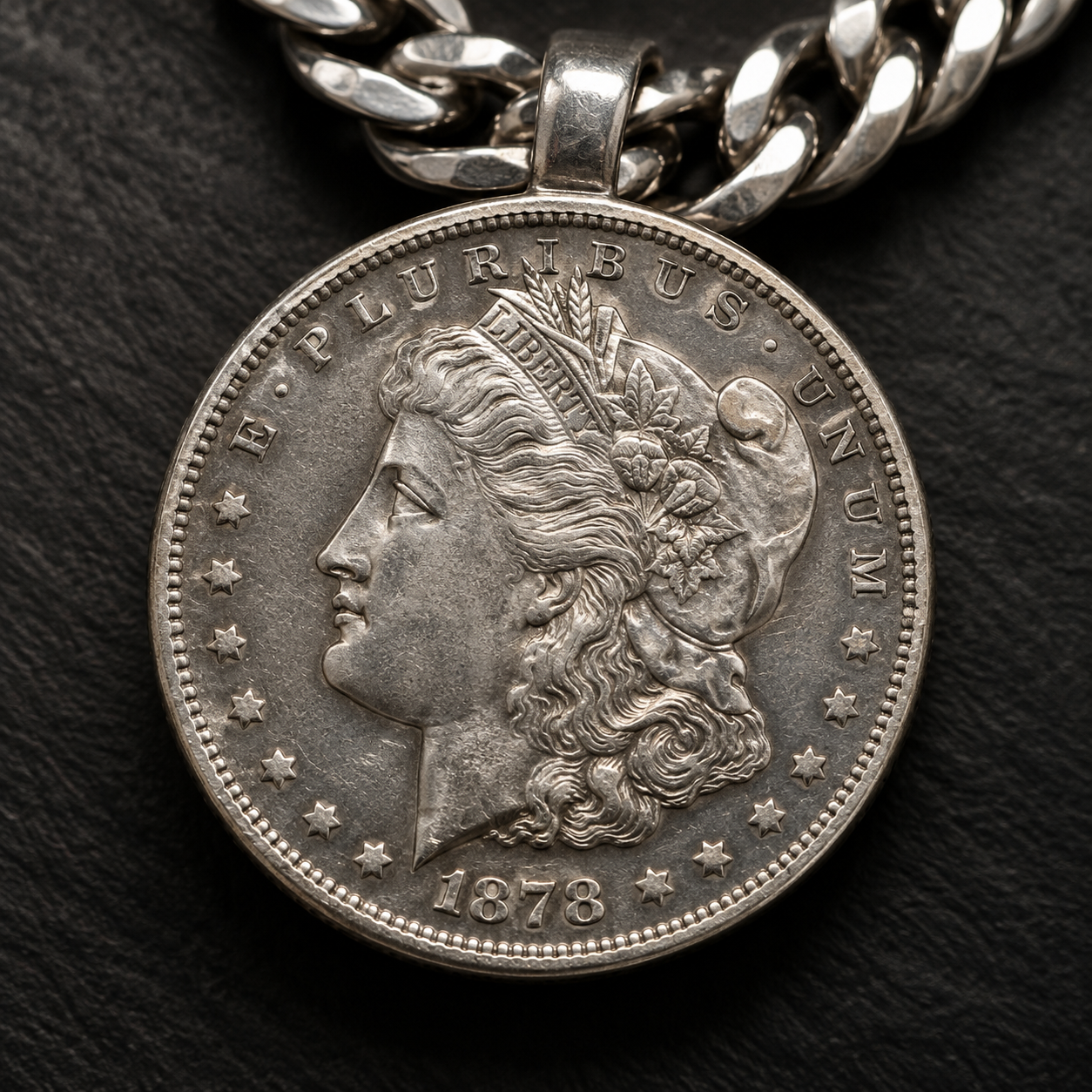
It was heavy, thick, and tarnished dark, bigger and heavier than any dollar coin he had ever handled. It looked nothing like the Sacagawea and Susan B. Anthony dollars Krista's boy Cameron used to steal from his dresser to blow on junk food. The edge carried faint, worn reeding. The relief showed lettering around an etched figure he couldn't quite place, and the weight of history hung off it like iron.
He looked up from the coin into the man's eyes.
"I got you," Shooter muttered. "Let me go get some cash."
The chime rang overhead as he pushed through the doors and walked past the coffee.
Shooter didn't touch drip coffee. The bitter sludge people brewed in industrial breakrooms tasted like battery acid. On the maybe two occasions a year he drank the stuff, at gunpoint, when winter settled into his joints, it was a hot vanilla latte with exactly seven yellow packets of Splenda. Normally he ran on sugar-free Liquid I.V. mixed with Crystal Light and a single can of Dr Pepper Zero. But on heavy mornings, when ten hours of Active Directory tickets, server cages, and fiber runs loomed in Building 480, he grabbed a cold Monster Rehab Peach Tea.
He pulled a tall can from the cooler and carried it to the counter. Beside the register sat the acrylic cases of Arizona Lottery scratch-offs.
Shooter despised scratch-offs. To him they were a voluntary tax on stupid people, paper scraps engineered to fleece suckers of the crumbs left over from their paychecks. He had never bought one in his life. At the craps table, at least, the shooter had the dice in his hand and the house edge was transparent. Scratch-offs were just blind, sucker math.
"Anything else, hon?"
His eyes drifted across the display and caught a heavy-foil ticket with bold, obnoxious lettering: Set for Life. $50 PER TICKET.
Fifty damn dollars for a square of cardboard.
The banner promised the ultimate pipe dream: $250,000 a year for twenty years. Five million bucks, paid out slow and steady, enough to wipe out the attorneys, buy Juan a bionic knee, pay Liz's tuition, fix Nik's Renegade, and leave him enough change to tell every corporate parasite on earth to shove it.
He turned fifty-one on Monday. His marriage was in the ditch, his headlight was blown, and he was about to trade money for an old hunk of metal in a convenience store parking lot. If he was already going off the rails, he might as well go all the way.
"Give me one of those fifty-dollar Set for Life scratchers," Shooter muttered, shaking his head at himself. "And twenty cash back, please."
He dipped his debit card, entered his PIN, and took the receipt, the tea, the oversized foil ticket, and a crisp twenty. He folded the scratcher once and shoved it flat into his back pocket. He had just officially joined the ranks of the stupid people.
The man hadn't moved an inch from the wall.
"Here," Shooter said, extending the bill.
A faint flicker of hesitation crossed the worn gray face. "I said ten."
"I know what you said. It's a really cool coin. Take the twenty."
The man didn't reach for the paper. He raised his left hand instead and flattened his calloused palm level at chest height, the silver coin resting motionless against his skin. He didn't offer to pass it. He didn't drop it into Shooter's fingers. He just held it out, waiting.
The unspoken requirement hung thick between them in the dark: you have to take it yourself.
Shooter paused for a beat, reading the silence. Then he reached out with his thumb and forefinger, pinched the heavy coin by its reeded edge, and lifted it clean off the stranger's palm.
The instant the metal broke contact with the man's skin, something shifted. It wasn't hot and it wasn't cold. It wasn't a shock or a vibration buzzing through bone. It was an unshakeable intuition dropping dead center into his chest: an absolute certainty that this piece of metal belonged to him now, and that under no circumstance should he let it leave his person.
Shooter laid the twenty in the man's empty palm.
"It's yours now," the man whispered.
Before Shooter could ask where the hell he'd found it, the stranger's mouth worked around something, a sentence reaching for the door and finding it locked. Then his lips closed. He folded the bill into his jacket, turned, and walked off toward the access road, and the dark took him without a backward glance.
Shooter dropped the coin into his front right pocket and felt its weight settle against his thigh. He walked back to the Ram Rebel, hoisted his 275-pound bulk up into the cab, and pulled the door shut with a clean, airtight thud.
The dash clock rolled over to 4:10.
High above the desert, something began to count.
Shooter didn't hear it. He cracked open the cold Monster, pressed the start button, and rolled out onto the asphalt. The wallet rode flat in his front left pocket. The scratcher sat forgotten in his back pocket. And against his right thigh lay a cold, heavy weight he kept touching without meaning to.
Across the dry mesquite brush, the passenger-side headlight cut a lone wedge of white toward Interstate 10.
Chapter Two
WEEK ONE · DAY ONE · CHAPTER TWO
"Adversary," Malaki said softly, "I can change the world with a single man and a single dollar."
High above the desert floor, where the freezing thermal drafts off the flats sheared against the black basalt spine of Picacho Peak, the physical laws of southern Arizona ceased to govern the air.
Between two towering stone columns hovered an eight-foot monolith of polished obsidian, a bottomless void that drank the thinning starlight, reflecting neither the sky nor the glowing sulfur coiling off Azazel's shoulders like burning wire.
Azazel stood at the western rim, an eight-foot tectonic fault line of cracked obsidian hide. Thick rivers of crimson magma pulsed beneath the plates of his neck, and his yellow slit-pupils were pinned to the valley floor, where a lone headlight crawled south along Interstate 10.
"A single headlight," Azazel rasped, his voice scraping like rebar dragged across broken pavement. "Fifty-one years of wear on the spine, fifty hours a week behind cipher locks, and a checking account bleeding out through the teeth of family court. A magnificent mark, Malaki. You couldn't have found a creature more thoroughly starved of hope."
Opposite him, motionless against the gale, Malaki stood draped in severe, unadorned silver vestments. The archangel held no mortal pride, only the calm, terrifying detachment of an auditor who already knew the numbers on the page.
"He was not selected, adversary," Malaki answered, his voice carrying the deep toll of temple bronze. "The previous vessel failed his trial and forfeited his light. The man at the wall asked ten dollars for an honest trade. The technician reached out and lifted the weight with his own hand. Agency remains unbroken."
"Agency?" Azazel let out a dry, rattling hiss that shook loose scree from the cliff face. "The man is an animal trapped in an enterprise cubicle. He hoards out of muscle memory. Give a starving stray a bone and he buries it with his teeth bared. Hand a broke defense technician the live current of infinite fruition, and watch how swiftly the brute panic of scarcity builds an iron fence around the vault."
He raised an ebony talon and rapped it against the floating ledger.
"Look at the record of that metal! It has broken every man who ever closed his fingers around it. The Doughboy pulled it off a corpse in the Argonne, survived the wire, and seven days later choked on mustard gas in a muddy trench. The Reno pit boss who took it in ninety-four watched his luck run clean for six days, and on the seventh the room went forty degrees colder and the frost crept across the floor. He did not die, Malaki. He still deals blackjack in Elko. Never misses a payout. Never smiles. And the wretch who stood shivering on that concrete this morning, hollow behind the eyes, was the last of them. They never give. They never tithe. And when hour one hundred and sixty-eight strikes, their spark defaults to the Pit."
"The artifact has no malice, Azazel," Malaki said, his golden eyes fixing on the demon. "It is an engine of pure probability, a tool no different than a carpenter's hammer or an optical transceiver. It carries neither virtue nor sin. Those men did not fall because of the silver. They fell because their own greed collapsed the structure. They took leverage with dirty hands."
"An engine of collapse!" Azazel barked, pacing the volcanic ledge. "Probability ceases to roll. It bends! If his mind fixes on a number, five hundred dollars for a repair, twenty dollars for fuel, the silver collapses every quantum register until reality matches his thought down to the cent. And if his mind is unfocused? If he acts without intent? The coin opens the tap to the absolute ceiling the machine or table allows."
"With one limit," Malaki said. "It cannot bend what eyes have already seen. A ball drawn on television is fixed. A card already turned is fixed. A ticket the clerk has scanned is fixed. Only what no one has yet perceived is soft."
"Which is every unturned card, every unthrown die, every unscratched ticket," Azazel purred, "and a world of them. He does not know. He cannot be told, not by you and not by me. That is the law, and I will not be accused of breaking it. He will feel something he cannot name, and he will explain it away, and he will clutch the harvest until it strangles him."
Malaki struck the slate with his open palm. The dark stone shuddered, and the unyielding rules seared themselves into the surface in blinding white script:
THE SEVEN-DAY COVENANT OF THE HOUSE
- The Touch. Probability bends for the holder while he is in contact with the coin, in hand or in a pocket, on any outcome no eyes have yet perceived.
- The 168-Hour Horizon. The holder keeps the coin for 168 hours. This governs the coin and nothing else.
- The Mandatory Tithe. Ten percent of all winnings taken from the house while the mortal holds the touch must be tithed with clean hands. The tenfold return is not winnings and bears no tithe. The tithe is reckoned once, over the full 168 hours, while the grace is paid each dawn.
- The Tenfold Grace. All wealth surrendered with clean hands returns tenfold at the following dawn, paid by the Adversary and deposited automatically into the mortal's primary checking account. All records, and all memories but his own, shall show it was always so. No power may revoke it. A gift is clean when it is given freely, from desire and not from duty, with no expectation of return. Duty is whatever the mortal would feel as failure if he withheld the gift.
- The Recursive Rollover. Should the mortal balance or exceed the tithe at the final second, the covenant renews for another 168 hours under identical conditions. Any surplus carries forward. An owed tithe does not carry: if unpaid at the final second, the Penalty follows.
- The Penalty of the Ledger. Should the accounts fail to balance when the chronometer strikes zero, the coin's share of all that the mortal holds is withdrawn from the world in proportion, by whatever means the world provides. The spark is drawn out and lost. He lives on as a husk, keeping only what the grace gave him.
Azazel dragged one black talon beneath the Fourth Statute.
"Tenfold," he murmured. "Paid from my reserve. Every clean dollar he gives away costs me ten."
"He is not told the law," Malaki said, pointing south through the black air at the lone headlight on the asphalt. "He is not told the price. And no gift is ever clean because he wants the return. A man who gives from duty has given nothing. A man who gives because a hand is empty or a burden is heavy, and asks for nothing, is credited in full."
Azazel's ember-veins burned a savage, predatory red as he leaned out over the abyss.
"The soul belongs to the Pit," he purred, savoring the syllables like warm blood. "When hour one hundred and sixty-eight strikes and the ledger fails, I will not grant him the mercy of death. A swift grave is grace, and the Pit offers no grace. I will press my talon into his chest, slip through the bone, and draw the light straight out from behind his ribs. I will leave his heart pumping and his lungs drawing air. But the spark behind his eyes will be snuffed out forever. A walking husk, doomed to sit behind an enterprise terminal for another twenty years, perfectly remembering the week he held the keys to paradise, knowing he traded eternity to hoard a handful of dust."
The demon turned back to the hovering ledger, his claws dragging across the basalt border as the numbers burned into life:
167:50:00
"Let the clock run," Azazel sneered into the wind. "At ten past four next Thursday morning, the metal will bury him just like the rest."
Down on the interstate, the desert run into Tucson in the predawn quiet had taken about forty minutes.
Shooter eased the Ram Rebel off the highway, worked the access loops toward Old Nogales Highway, and joined the queue at the security perimeter of Raytheon Building 480. Out over the front bumper, the solitary passenger-side projector cut its lonely swath through the ink of the desert morning. The driver's side remained dead and dark.
He reached up to make sure his facility badge was still clipped to the lanyard. His fingers brushed his right front pocket, and the silver piece resting there, dense and cold.
It wasn't buzzing, and it wasn't glowing. Yet, sitting alone in the idling cab with nothing in front of him but chain link, concertina wire, and the yellow floodlights of the checkpoint, a sudden, inexplicable static pricked the back of his neck. It felt like the air right before a monsoon lightning strike, or the electromagnetic hum outside a high-voltage server bay.
For no clear reason, and to absolutely no one, Shooter looked through the windshield and muttered:
"Whatever today's got, bring it."
He touched the throttle and rolled toward the gate.
Chapter Three
WEEK ONE · DAY ONE · CHAPTER THREE
The badging turnstiles outside Raytheon Building 480 chimed with an unfeeling electronic tone as Shooter cleared the perimeter gate and stepped through the double airlock doors.
The transition was immediate. Outside, the desert morning was still locked in predawn ink. Inside, the temperature dropped to a controlled sixty-six degrees to keep rows of enterprise compute nodes from cooking their processors. The white-noise roar of floor-grate blowers, air handlers, and redundant chillers hit him like a solid wall, a steady sixty-decibel hum that erased the chaos of the outside world.
Shooter ambled down the wide linoleum corridor in his worn slip-on Skechers, his feet making no sound on the antistatic tile. No boots, no stiff leather, no corporate overshirt. Because it was the Thursday before an off Friday, the facility was under casual dress rules, leaving him comfortable in dark jeans and Tonya's black Nope shirt, his six-foot-one, 275-pound frame moving with unhurried purpose. His keys clinked softly against the heavy silver dollar in the pocket beneath.
He turned into his cubicle bay: a gray fabric enclosure with twin 24-inch displays, a monitor arm holding the 30-inch display for his secure terminal, and a mechanical keyboard whose keycaps had worn smooth.
He dropped into the high-back mesh chair. The pneumatic cylinder hissed a weary protest before bottoming out against the stop. He popped the tab on an ice-cold Dr Pepper Zero from his floor bag and set it on a lint-free antistatic cloth to protect the laminate.
On his primary display he launched a terminal session and kicked off an automated patching script to roll updated security baselines across sixty air-gapped domain controllers. On the secondary screen, eighteen fresh Active Directory tickets sat rotting in the queue from facility users who had locked themselves out of internal shares before the sun had cleared the Rincon Mountains.
It was barely ten to five. The building was a ghost town. Plant security hadn't opened for hardware escorts yet, which meant nobody would be turning a screw or popping an enclosure on classified hardware for hours.
Two cubicles down the aisle, a task chair screeched across the floor.
Darren leaned out into the opening. Sixty-two years old, with a gray goatee that twitched whenever an unverified user submitted a priority-one ticket, he peered over the top of his wire-rimmed bifocals with a mug of bad facility drip balanced in his left hand. Darren was a senior systems administrator who had worked defense contracts long enough to trust server logs more than people.
"Hey, Shooter."
"Yeah," Shooter grunted, fingers flying across the keys without looking up.
"You got that precision driver set? The one with the micro-Torx bits?"
Shooter paused and turned his head. "What do you need Torx bits for at five in the morning?"
"Not for the server hardware." Darren nudged the bridge of his glasses with a knuckle. "The hinge screw backed clean out of the left arm on my bifocals, and the spare sunglasses in my glovebox are flopping loose. Those drugstore kits have soft pot-metal drivers that strip the head every damn time. Figured I'd borrow your German kit so I don't punch a lens out trying to tighten a micro-screw."
"Hold on."
Shooter planted his palms on the armrests and heaved up out of the chair, his lower back popping a dull complaint, and stepped around his desk to the heavy gray lateral file cabinet in the corner.
As he turned his back and bent to yank the lower drawer open, the black Nope shirt rode up an inch over his waistband. Tucked flat in his right rear pocket, the oversized metallic-green foil of the Arizona Lottery Set for Life ticket poked out by a clean two inches, the white lettering catching the fluorescent glare.
Darren stood at the edge of the partition, waiting. His gaze dropped over the top of his glasses, locked on the neon banner, and his goatee twitched once.
Shooter, a die-hard systems administrator who had spent years preaching to anyone who would listen that scratch-offs were a predatory tax on stupid people, had a fifty-dollar pipe dream riding on his hip.
Darren didn't blink, and he didn't say a word.
Darren had survived enough defense plant politics, corporate restructuring, and bad divorces to live by an ironclad rule: it wasn't his business what a grown man did with his money, and it sure as hell wasn't his business what a grown man carried in his pants. If a fellow tech wanted to burn fifty dollars on lottery foil, carry an odd poker chip, or set cash on fire in the parking lot, that was between him, his checking account, and God Almighty.
Shooter's fingers found the small red-and-black Wiha case under a mess of spare Cat6 patch cords. He kicked the drawer shut with the heel of his Skecher, turned around, and held it out.
"Don't lose the T8 bit. Everybody steals the damn T8."
"I only need the micro-flathead for the hinge," Darren said dryly, taking the kit without batting an eye. "I'll have it back on your desk before lunch."
He tapped two knuckles against the divider.
"Brenda's meeting me in the south lot at 1445. We're heading straight across Old Nogales Highway to Desert Diamond to hit the buffet and feed twenty bucks to the penny slots. You coming across the blacktop, or are you going straight back to Marana to listen to that woman litigate the kitchen cabinets again?"
Shooter let out a low, weary breath through his nose. Beneath his jeans, the silver dollar seemed to radiate a cold, grounding anchor against his thigh.
"My birthday's Monday," he muttered, easing back into the chair. "Desert Diamond probably dropped twenty-five bucks of pity play on my rewards card. Might as well let them buy me a bottle of water."
"That's the spirit." Darren turned on his heel with the Wiha set. "Don't be late. I don't want to be standing in the casino lobby holding Brenda's purse."
He wandered back down the aisle. Shooter took a cold pull of Dr Pepper Zero, clicked back into his terminal, and settled in for the long haul until half past two, watching the minute counter on his taskbar drag its feet toward the afternoon.
Chapter Four
WEEK ONE · DAY ONE · CHAPTER FOUR
The shift whistle at Building 480 had barely finished echoing when Darren met Brenda in the south lot.
Shooter fell in behind them, the Ram Rebel rumbling across the blacktop toward Old Nogales Highway with the lone passenger-side projector throwing its pale beam over the pavement, though the afternoon sun made it pointless. He had pulled one hundred-dollar bill from the Wild Horse Pass envelope in the console, the last of the five hundred left over from the night The Bluff denied him at the crapless table. Four hundred stayed in the truck.
The afternoon sun hammered the Tucson Mountains as they crossed into Desert Diamond.
Inside, the air smelled of stale carpet, ozone, and cooking oil drifting from the buffet. Hundreds of slot machines chimed and flashed beneath the ceiling lights, each promising a fortune to anyone foolish enough to believe it.
At the rewards counter Shooter slid his license across the Formica. "My birthday's Monday. Figured you folks might've dropped some pity play on my card."
The clerk tapped a few keys and slid a fresh rewards card back. "Twenty-five dollars in promotional credits, Mr. Freeman. Happy early birthday."
"Appreciate it."
He found Darren and Brenda in the penny section. Brenda was already working a Buffalo machine, tapping the minimum bet with the practiced indifference of someone who expected to lose. Darren stood behind her, thumbs hooked in his belt loops, watching the reels.
Shooter settled onto the oversized vinyl stool at the adjacent Buffalo Gold terminal.
"Anything good?" Darren asked.
"Just feeding the electronic goat."
He slipped his rewards card into the reader and fed the hundred into the validator. The plan was simple: burn through the free twenty-five, collect whatever remained of the hundred, and go eat.
Before he could place a bet, Gloria appeared at his elbow with a black service tray balanced on one forearm. Her name tag hung crooked on her vest. She looked tired in the way people did after hours on concrete, but she still managed a smile.
"Evening, boys. Brenda. What can I get you?"
"I'd kill for a cold bottle of water."
Shooter checked his pockets. Wallet, keys, the heavy silver coin. Not a single left.
"Damn. The only bill I had went in the machine."
Darren pulled two singles from his pocket and dropped them on Gloria's tray. "I got you, buddy. Three waters, Gloria. Make 'em cold."
"Coming right up."
"I'll catch you back at the shop Monday," Shooter said.
"Shut up and spin your free twenty-five."
Shooter turned back to the machine.
He meant to select the penny denomination and make the smallest bet possible. But his attention wandered. The blown headlight still needed replacing. Family court wasn't going away. And beneath the denim of his right front pocket, the old silver dollar rested against his thigh, cold and strangely heavy.
His thumb moved.
He pressed the wrong button.
MAX BET.
The screen flashed. WAGER: $50.00.
"Ah, shit." Shooter stared at the display. "Fat-fingered the damn key."
He hadn't imagined a winning combination. He hadn't pictured a dollar amount. He hadn't wished for anything beyond getting through the evening without spending more than he'd intended.
The coin didn't need a number. It took the wager and pushed probability as far as the machine would allow.
The reels snapped into place. CLANG. CLANG. CLANG. CLANG. CLANG.
Five golden coins.
Shooter leaned forward. Three coins triggered the bonus and awarded eight free spins. Four gave you twelve. Five awarded sixteen, the maximum the machine allowed. But the extra spins were only half the story. Every free spin gave the machine another chance to land gold buffalo heads. Collect enough of those heads, and entire groups of lower-paying animals disappeared from the reels, replaced by the highest-paying buffalo symbols. Eagles went first, then mountain lions, followed by moose and elk. Wolves were last.
Five coins didn't guarantee a fortune. They gave you the best possible chance to build one. In thirty years of wandering through casinos from North Carolina to Nevada, Shooter had never seen all five land together.
"Well, I'll be damned."
Darren stepped closer. Brenda stopped pressing her own spin button. The screen dissolved into the bonus feature, and Shooter tapped the glass.
On the first spin, four gold buffalo heads appeared. A bright electronic fanfare sounded, and every eagle vanished, replaced by buffalo. On the second spin, three more landed and the mountain lions disappeared. Two spins later, the moose and elk were gone. By spin eight, only the wolves remained on the ladder, demanding twelve gold heads before they would go, and Shooter had never seen anyone come close to clearing them. The machine kept paying.
By spin twelve, the coin-drop sound had become one continuous rattle. A woman abandoned the machine beside Brenda to watch. Two men stopped in the aisle. Within a minute a small crowd had formed behind Shooter's stool.
Spin fifteen dropped the final gold heads. A digital gong rang through the cabinet. Every wolf flashed gold and became a buffalo. There wasn't a single low-paying animal left on the reels.
And he still had one spin remaining.
"Son of a bitch," Darren breathed.
Deep in Shooter's pocket, the silver coin gave a single icy pulse.
Spin sixteen began. The first reel stopped: five buffalo. The second: five more. The third locked into place. The fourth slammed down. For one impossible second, the fifth reel kept spinning. Shooter held his breath. It stopped. Buffalo from top to bottom, every reel, every position, the entire screen.
The machine gave a shrill electronic whine. The celebration music cut out, replaced by a two-tone alarm. The overhead beacon erupted in red and amber. Then the reels vanished behind enormous crimson letters:
HANDPAY JACKPOT · ATTENDANT ASSISTANCE REQUIRED · $47,943.64
Shooter didn't move. Forty-seven thousand, nine hundred forty-three dollars. And sixty-four cents. The sixty-four cents bothered him more than it should have.
Darren studied the screen through his bifocals. "Well, that sure as shit ain't fifty cents."
"I meant to press the middle button."
The crowd laughed. Shooter didn't. He was still trying to work out how a fifty-dollar mistake had turned into more than half a year's salary.
Two uniformed tribal officers cleared a path while a slot supervisor approached with an aluminum clipboard. She checked the machine, verified the payout, and began the paperwork.
"Do you want federal taxes withheld tonight, Mr. Freeman?"
"Hell no. Give me the W-2G. Uncle Sam can wait until April like everybody else. I'm not giving the federal government an interest-free loan on money I made five minutes ago."
She smiled and kept writing. "Gross payout is $47,943.64. How would you like it?"
"Cashier's check for forty grand, made out to David Freeman. Five thousand in hundreds."
"That leaves $2,943.64."
"Give me the rest in cash. Hundreds, twenties, singles, whatever gets it right."
When the money came, Shooter folded the fifty hundred-dollar bills into one pocket and the cashier's check into another. Forty-five thousand dollars. His blown headlight was suddenly the least of his problems.
The remaining $2,943.64 sat on the payout tray.
Shooter looked at it. He had a rule. No money for anybody with a hand out. If he had to work for his, so did they. But nobody at this machine had a hand out. Darren had worked defense contracts for thirty years and had never once asked anybody for anything. Gloria had been on concrete for hours and hadn't asked for a thing. Those hands were already full. And Shooter found he wanted, with a force that surprised him, to put something in them.
He counted twenty hundred-dollar bills off the stack, turned, and pressed them into Darren's hands.
"Here."
Darren looked down. "What the hell is this?"
"Two grand."
"I can count, Shooter."
"Because you're one of the good ones. Don't make it weird."
"Shooter, I tipped Gloria two bucks. That's all I did."
"I know what you did. Take it."
Darren looked at Brenda, who looked just as stunned as he did. Then he looked back at Shooter. For once, the veteran sysadmin had nothing to say.
Gloria came back through the crowd with three cold bottles of water. She slowed when she saw the officers, the flashing machine, and the money on the tray.
"Lord have mercy. What happened here?"
"Apparently I pushed the wrong button," Shooter said.
He took a bottle, twisted off the cap, and drank. Then he gathered the rest of the payout: nine hundred in hundreds, forty in twenties, three singles, sixty-four cents. He set every bit of it on her tray.
She froze. "Sir?"
"That's yours."
"Oh, honey, no. I can't take all that."
"Sure you can."
"That's almost a thousand dollars!"
Shooter screwed the cap back on his water. "That's for carrying water on concrete, Gloria. Take it and tuck it in your apron before the shift lead decides to quote company policy at you."
Gloria stared at him, then at the money. Her eyes shone.
Shooter turned back to Darren before she could argue.
Out on the basalt spine of Picacho Peak, Azazel's talons scraped across the obsidian ledger as the numbers burned into its surface:
- GROSS EXTRACTION: $47,943.64
- TITHE DUE AT HOUR 168 (10%): $4,794.36
- CLEAN GIVING TO DATE: $2,943.64
- SHORTFALL TO DATE: $1,850.72
- LEDGER STATUS: OPEN
"Forty-five thousand tucked away for himself!" Azazel roared into the wind. "Two grand to his drinking companion, scraps to the serving girl, and still nearly two thousand short!"
Malaki stood opposite him, silver vestments motionless against the gale, golden eyes on the ledger.
"The ledger closes at hour one hundred and sixty-eight, adversary, not before. He surrendered nearly three thousand dollars without knowing the price of keeping it. Do not confuse the opening move with the endgame."
Back on the casino floor, Shooter slipped the cashier's check deeper into his pocket and climbed off the stool. Darren was still holding twenty hundred-dollar bills. Brenda was staring at Shooter as though he'd grown a second head.
He gave them both a slow, dry smile.
"Rain check on the buffet," he said. "Monday.Lunch. It's on me."
Chapter Five
WEEK ONE · DAY ONE · CHAPTER FIVE
The heavy glass doors of Desert Diamond hadn't finished swinging shut behind Shooter before tribal security closed ranks.
It wasn't a hostile shakedown, but in a tribal casino on a Thursday evening, an unassuming man in worn slip-on Skechers walking away from a penny terminal with a forty-thousand-dollar cashier's check and fifty crisp hundreds in his denim was a walking security incident. Two burly officers in charcoal uniforms, hands resting with practiced nonchalance on their duty belts, flanked his shoulders and guided him across the transition corridor and out into the low gold light of the south blacktop.
"For your own safety, Mr. Freeman," the lead sergeant murmured, eyes scanning the lot. "A hit like that draws eyes from the bar before the tickets even print. We have a duty of care to see you safely to your vehicle."
"Appreciate the escort, boys," Shooter rumbled. "Saves me explaining to some drifter why my pockets are full."
They walked him to the driver-side door of the Ram Rebel. At the door he reached into the console, pulled two hundreds from the Wild Horse Pass envelope, and pressed one into each officer's palm. "Sir, that isn't necessary," the sergeant said. "Never said it was," Shooter answered. Then he climbed his 275-pound bulk up into the cab, pulled the door shut with an airtight thud, and pressed the start button.
It was half past five on the dot when the tires cleared the casino apron. The lone passenger-side projector cut its solitary white wedge through the afternoon glare, the dead driver-side assembly keeping one eye permanently blind as he nosed out onto Old Nogales Highway toward Interstate 10.
The forty-five-minute run north was pure mechanical transit. Thursday traffic had thinned enough along the frontage roads to let the Pentastar cruise, the drone of the tires blending with the dull ache in his lower spine and the bone-deep exhaustion of nine hours of enterprise patching scripts in Building 480.
At six-fifteen he backed into the Marana garage by habit, nose-out, and killed the engine.
Inside, the house smelled like cold pizza and air conditioning. Nik was glued to his gaming monitor in the back room with his headset clamped on, fingers mashing keybinds. Liz was sprawled across the sofa scrolling her phone and barely glanced up as the deadbolt clicked. Trevor's door was shut, a bar of blue television light along the bottom.
"Hey, Dad," Liz said without breaking her scroll. "You're late."
"Ran into some traffic on Nogales." He kicked off his Skechers by the door.
Bacon trotted over with a soft, inquiring whimper and sniffed at Shooter's jeans, catching the sharp, alien scents of casino ozone, cigarette smoke, and deep-fried appetizers. Shooter gave the dog's broad skull a heavy, affectionate scratch behind the ears.
"Go lay down, buddy."
He didn't make a speech about winning nearly forty-eight grand. He didn't wave the check or show off the banded hundreds. He set his wallet, with the cashier's check folded inside, and his key ring on the kitchen island. The fifty hundreds stayed in his front pocket, because a man doesn't leave five thousand dollars in cash lying on a counter in a house with two teenagers and a brother-in-law. The coin stayed where it was. He didn't think about why.
He grabbed a cold Dr Pepper Zero from the fridge, peeled off the black Nope shirt, and padded upstairs. He was too tired to take off the jeans. He collapsed across the bed with the foil scratcher still forgotten in his back pocket and the silver dollar still heavy against his thigh, pulled the top sheet over his shoulder, and within ninety seconds was dead to the world, snoring into the mattress while the ceiling fan turned lazily overhead.
The night had barely begun.
Out on Picacho Peak, northwest of the quiet house, there was no sleep to be had.
Azazel stood before the hovering obsidian monolith, his eight-foot volcanic frame trembling with a sickening, shuddering fury. The rivers of molten magma in his neck plates had dimmed to a sputtering orange, and his talons dug smoking gouges into the edges of the stone.
"Three thousand, one hundred forty-three dollars and sixty-four cents!" Azazel shrieked, the sound tearing through the Sonoran night like a bandsaw chewing rusted sheet metal. "Nine hundred forty-three to a cocktail waitress, two thousand to a coworker, and two hundred to a pair of rent-a-cops! He had the hoard in his fists, Malaki. He was supposed to clutch it. He was supposed to build a wall around himself!"
Opposite him, suspended in the freezing gale, Malaki stood motionless, silver vestments catching the cold starlight, golden eyes fixed on the script carving itself into the slate.
"The Fourth Statute," Malaki recited, with the immovable authority of temple bronze. "The mortal gave without leverage. He gave without pride. He gave without demanding a single crumb of reciprocity, and he gave from desire and not from duty. The math is absolute, adversary. Ten times three thousand, one hundred forty-three dollars and sixty-four cents is thirty-one thousand, four hundred thirty-six dollars and forty cents. Payable from your reserve before the sun rises."
"More than thirty thousand dollars of my own substance for a waitress, a sysadmin, and two guards." Azazel's fangs ground together with a sound like crushing gravel. "I cannot take it back?"
"No power can take it back. Not yours. Not mine."
"Then let me see it done."
He lunged over the slate, claws flying across the celestial runes. The obsidian flared, and the ledger burned into its surface:
- GRACE PAYMENT DUE AT DAWN: $31,436.40
- TARGET: SHOOTER'S PRIMARY CHECKING (AUTOMATIC)
- TITHE LEDGER: OPEN, $1,650.72 SHORT, CLOSES AT HOUR 168
"There," Azazel rasped, his voice dropping into a bitter, venomous whine. "Done. And when the sun comes up, the bank will tell him the money has always been there. His employer will tell him. The state will tell him. Every record on earth will agree, and every living soul with it, and he will be the only man alive who remembers what the number was yesterday."
The demon's yellow eyes burned.
"A man who knows the world is lying to him, and cannot prove it, and cannot tell a soul, Malaki, learns to trust nothing. He learns to build walls. He learns to hold on. I do not need to whisper to him. I only need to let him count."
Malaki looked down through the darkness toward the quiet house in Marana, where Shooter lay fast asleep, Bacon was sprawled on the living room rug below.
"You keep assuming he is fighting you for wealth, adversary," Malaki said softly, fading back into the starlight. "He is only keeping his variables tidy."